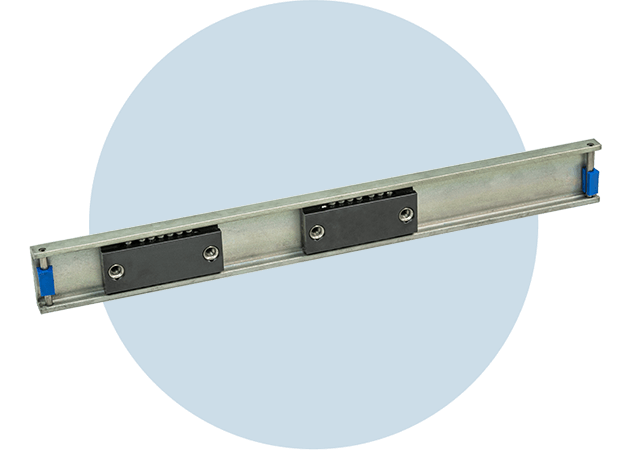
Sliding rails manufactured by Chambrelan
A range of quality sliding rails
Discover our range of sliding rails. These heavy-duty guides are ideal for all your technical projects. To meet all the needs of the different fields of application in which our sliding rails can be integrated. We offer two different rail types: sliding rails with roller runners and ball bearing sliding rails. Learn more
Filters
1. How are Linear rails manufactured?
Linear rails consist of a fixed rail fitted with ball-bearing or roller runners. The runners move inside the rail through a recirculation or rolling system. They are precisely matched to the rail to ensure smooth and consistent travel. The rail, manufactured from cold-drawn steel, offers high resistance to heavy loads and is treated against corrosion.
2. Why choose Chambrelan Linear rails?
Since 1956, Chambrelan has designed and manufactured its Linear rails in France and supplies them worldwide. The company relies on recognised expertise to deliver robust, reliable products tailored to industrial requirements.
3. What is the load capacity of Linear rails?
Chambrelan Linear rails are engineered to support heavy loads while ensuring smooth movement. With 15 runner models and 8 available lengths, they suit a wide range of configurations, including installations with restricted space. Each runner can support loads from 5 to 600 kg depending on its design.
4. How is a Linear rail installed?
Linear rails are available in standard lengths up to 2 metres and can be mounted end to end. Drilling is optional and is only carried out upon specific request. Each runner is drilled to allow the fixing of your equipment, and end stops are supplied.
5. What is cold-drawn steel used in Linear rails?
Cold-drawn steel is mechanically processed to increase its hardness. This enhances the rail’s resistance to wear and mechanical stress. Certain models may also be available as Aluminium sliding rail versions.
6. Do Linear rails require maintenance?
Linear rails are factory pre-lubricated with high-pressure bearing grease. Under normal operating conditions, annual re-lubrication is sufficient. In demanding environments (dust, high cycle rates), more frequent maintenance is recommended. All rails are supplied with anti-corrosion treatment.
7. Are bespoke Linear rails available?
Yes. Chambrelan offers customised solutions: length, drilling pattern, surface treatment, lubrication type and accessories can be defined according to your professional requirements. Please contact us to discuss your project.
8. What temperature range can Linear rails withstand?
Standard versions operate within a temperature range of -20°C to 80°C. For extreme environments, we offer runners capable of withstanding temperatures from -65°C to 400°C. This requirement must be specified prior to ordering.
9. What is the difference between ball-bearing and roller runners Linear rails?
Differences between the two solutions:
- Ball-bearing linear rails: robust solution capable of supporting high loads, ideal for industrial environments. May generate slight operational noise.
- Roller runners linear rails: provide smooth and quiet linear guidance. The central roller is adjustable, allowing easy clearance adjustment during installation.
10. What is the purpose of a scraper kit for Linear rails?
The scraper kit is fitted to certain runners to remove large contaminants. It protects the raceway and extends the service life of the rail in dusty or dirty environments.